
Breast Lift Scars: What Each Incision Pattern Leaves Behind
Jump To Section
After pregnancy and breastfeeding, many women find that their breasts sit lower, the nipples point down, and the upper part of the breast looks flat. A breast lift, or mastopexy, restores a higher, more youthful position. But the most common question during a consultation isn't whether a lift will help. It's "How big will the scars be?"
Here's the short version. Scar length and shape control are tied together. The incision pattern decides how much skin can be removed, how the breast can be reshaped and how well that shape holds over time. Dr. Joubin Gabbay, a board-certified plastic surgeon in Beverly Hills, chooses the pattern for each patient based on how much lift she needs, then places the scars where they're easiest to hide. This guide shows where each scar sits and how it fades, and you can watch Dr. Gabbay walk through his breast lift approach here.
Key takeaways
The right incision is the one that matches how much your breasts have dropped and how much skin needs to be removed, not the one with the shortest scar.
A scar around the areola alone (the donut lift) works best for mild lifts. Asked to do more, it can flatten the breast and widen the areola.
The lollipop pattern suits many moms with moderate sagging. The anchor pattern gives the most control for significant sagging.
Dr. Gabbay's approach focuses on reshaping the breast tissue itself for long-term support, not just removing skin.
Breast lift scars usually fade considerably over 12 to 18 months.
What a breast lift actually changes
According to the American Society of Plastic Surgeons, a breast lift "raises the breasts by removing excess skin and tightening the surrounding tissue to reshape and support the new breast contour." It can also reduce areolas that have stretched. What it doesn't do is significantly change breast size or add fullness to the upper breast. If you'd like more volume, see Breast Lift Without Implants.
Every lift comes down to a few core steps: keeping the nipple attached to its blood supply, removing excess skin, repositioning tissue, and creating a natural teardrop shape. Keeping the nipple connected to the tissue underneath it, instead of removing and regrafting it, helps preserve sensation and, for many women, the potential to breastfeed later.
The incision pattern controls how much of that reshaping is possible.
The four incision patterns, explained
There are four main breast lift approaches. Each trades scar length for control.
Crescent lift
A small half-moon of skin is removed along the top edge of the areola. It can raise the nipple very slightly or correct minor asymmetry. Because it removes so little skin, it rarely helps after pregnancy, when sagging typically involves the whole lower breast.
Periareolar (donut) lift
A ring of skin is removed around the areola, and the outer edge is gathered in with a purse-string stitch. The only scar sits at the edge of the areola. This sounds ideal, and for very mild cases it can work. The problem is what happens when it's asked to do more.
Vertical (lollipop) lift
An incision goes around the areola and runs straight down to the breast crease. This allows the surgeon to narrow the lower breast, lift the tissue, and create projection. It works well for many moms with mild to moderate sagging.
Anchor (inverted-T) lift
The lollipop incision plus a horizontal incision hidden in the crease under the breast. This gives the most control over skin removal and shape, and it's often the best choice for significant sagging or large, heavy breasts after nursing.
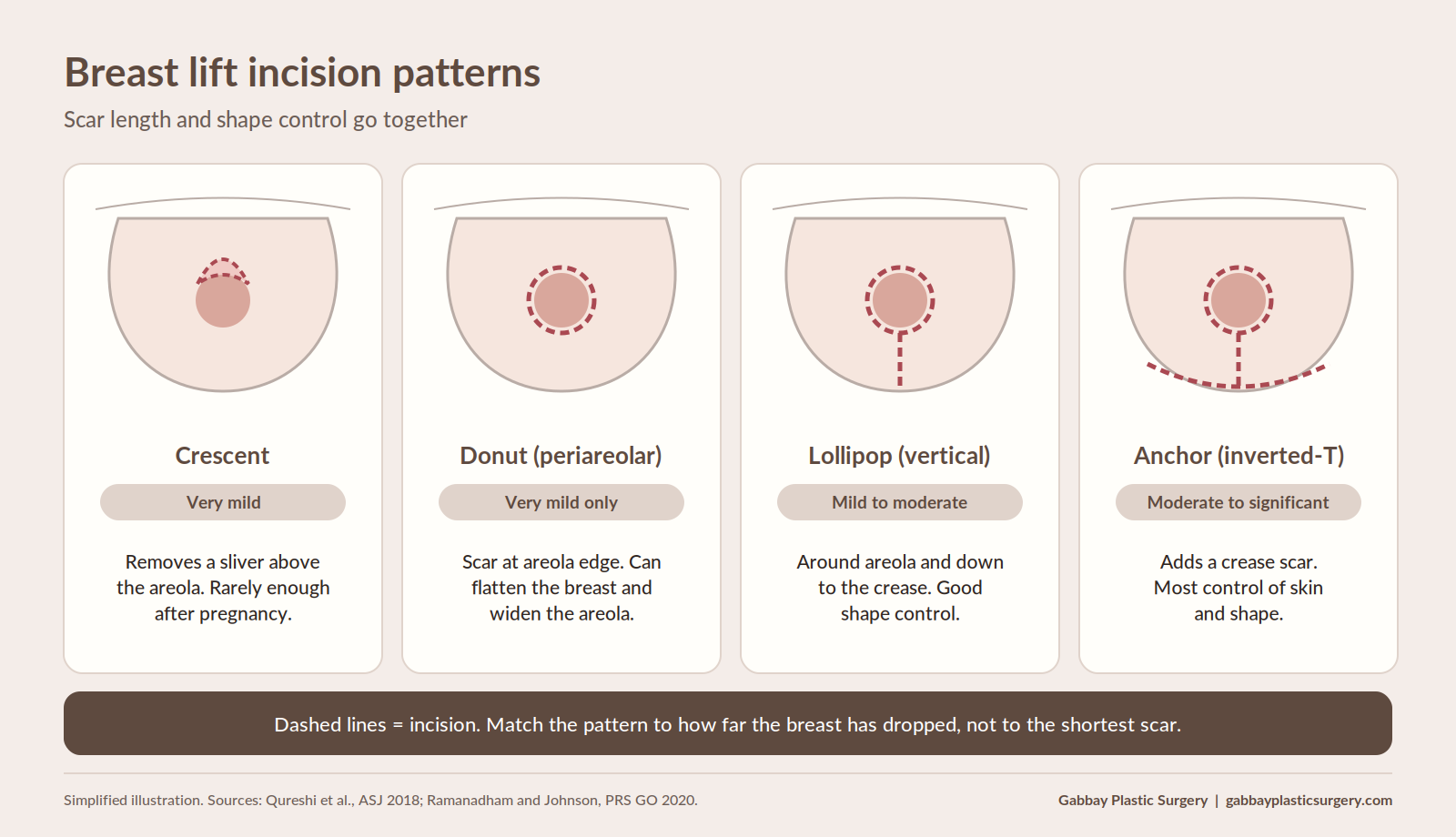 Four breast outlines showing crescent, donut, lollipop, and anchor incisions, each labeled with the degree of sagging it typically suits and its main trade-off.
When is a donut lift enough?
A donut lift has one real advantage: the scar is confined to the areola. The drawback is mechanical. When you remove a ring of skin and cinch the outer edge down to the size of the areola, the tension goes around the circle and pulls the breast flat from the front. Over time, that tension can also stretch the areola back out and widen the scar.
A 2018 review of mastopexy techniques in Aesthetic Surgery Journal explains that the periareolar approach "removes skin in a concentric pattern and this can lead to flattening and deprojection of the breast," and that periareolar mastopexies "have high rates of revision and patient dissatisfaction." In the data it summarizes, "periareolar mastopexies had the highest revision rate at 50%" (Qureshi et al., Aesthetic Surgery Journal). A separate primer for plastic surgeons lists widened scars, a widened areola, central flattening, and pleating among the complications (Ramanadham and Johnson, Plastic and Reconstructive Surgery Global Open).
Every pattern has trade-offs. The same primer notes that vertical lifts see more asymmetry and anchor lifts more commonly "bottom out," meaning the lower breast stretches over time. Good internal support, covered below, is how surgeons reduce those risks.
For a small lift, a donut pattern can be a great fit. After pregnancy, though, many women need more lift than a ring of skin can safely deliver. The goal is to choose the pattern that can create lasting shape, not the one that sounds smallest in the consultation room.
How the right incision is chosen
Choosing the right incision for you starts with an exam. Dr. Gabbay looks at:
How far the nipple has dropped. If the nipple sits at or below the breast crease, more vertical and often horizontal skin needs to be removed. Our post on Breast Lift vs. Implants in a Mommy Makeover explains the grades of sagging.
Skin quality. Stretch marks and thin skin after pregnancy hold shape less well, so more internal support and sometimes more skin removal is needed.
Breast size and weight. Larger, heavier breasts usually benefit from an anchor pattern that can remove skin in both directions.
Whether volume is being added. Implants or fat change how much skin needs to be removed.
Asymmetry. Pregnancy often changes one breast more than the other, and each side may need a different amount of correction.
In Dr. Gabbay's approach, the choice is individual, and each breast may need something slightly different.
Degree of sagging | Typical pattern | Main trade-off |
|---|---|---|
Very mild, nipple slightly low | Crescent or small periareolar | Short scar, very limited lift |
Mild to moderate | Vertical (lollipop) | Vertical scar, good shape control |
Moderate to significant | Anchor (inverted-T) | Longest scar, most control |
A whole-breast approach to lasting support
Removing skin lifts the breast, but skin alone doesn't hold shape well over time, especially skin that's been stretched by pregnancy. That's why Dr. Gabbay uses the breast's own structure for long-term support, what he calls a whole-breast approach. In practice, that means reshaping and repositioning the breast tissue itself so the internal structure carries the new shape, and the skin simply drapes over it.
This is also where auto-augmentation comes in. For some women, tissue from the lower part of the breast that would otherwise be removed can be moved upward to fill the upper breast. Dr. Gabbay offers breast auto-augmentation as an option for moms who want a fuller look without implants.
 Breast lift by Dr. Joubin Gabbay. Individual results vary.
 Breast lift by Dr. Joubin Gabbay. Individual results vary.
When a lift is combined with implants
Many moms want their shape and their volume restored at the same time. A single-stage breast lift with implants is common and generally safe for well-selected patients. A systematic review of 4,856 cases of combined augmentation and mastopexy found a pooled complication rate of 13.1% and a reoperation rate of 10.7%. Recurrent sagging occurred in 5.2%, and poor scarring in 3.7% (Systematic review, Plastic and Reconstructive Surgery).
When an implant is added, the incision plan changes. The implant fills out some of the loose skin, so the surgeon removes a little less, and the pattern is chosen to support the implant's weight over time. Dr. Gabbay performs breast augmentation with a lift and will explain whether one stage or two makes more sense for your tissue.
 Breast augmentation with lift by Dr. Joubin Gabbay. Individual results vary.
What to expect from breast lift scars
Every breast lift leaves scars. The goal is to place them where they're easiest to hide and to create a shape that makes the trade-off worthwhile.
Around the areola: Blends with the natural color change at the edge of the areola.
Vertical: Runs from the bottom of the areola to the crease. Usually the most visible scar early on, and it typically fades well.
In the crease: Hidden under the breast and by most bras and swimsuits.
Breast lift scar timeline
When | What your scars usually look like |
|---|---|
Weeks 1 to 2 | Closed and covered. Some swelling and bruising. |
Weeks 3 to 6 | Pink and slightly raised. Bruising is mostly gone by 2 to 3 weeks, and most swelling fades by 4 to 6 weeks. |
Months 2 to 6 | Red or pink, sometimes firm. This is the stage that worries people most, and it's normal. |
Months 6 to 12 | Flatter, softer and lighter. |
Months 12 to 18 | Pale, thin lines for most women. |
Scars keep improving for well over a year. Silicone scar products, sun protection and not smoking all help. Some patients soften their scars even more with nonsurgical treatments after healing. The surgery itself takes one to four hours, and most patients plan for about two weeks of downtime.
Want to see healed scars on women with a shape like yours? Book a breast lift consultation and ask to see results at different stages.
Timing a lift after pregnancy
Breast shape keeps changing for several months after you stop nursing. Most surgeons recommend waiting until your breasts have stabilized, usually at least three to six months after breastfeeding ends, and until you're close to a stable weight. Breast surgery can still be done if you're planning another pregnancy, although a future pregnancy may change the result. For more on timing, see When Is the Best Time to Get a Mommy Makeover?
Frequently asked questions
Which breast lift incision is best after pregnancy?
It depends on how much your breasts have dropped. Many moms with moderate sagging do well with a lollipop lift. Significant sagging usually needs an anchor lift for the best shape.
Is a donut lift a good choice?
For a mild lift, it can be. When used for more than a small lift, the purse-string closure around the areola can flatten the breast, widen the areola, and stretch the scar. Published reviews report high revision rates with periareolar lifts.
Can I choose a smaller scar if I'm willing to accept a smaller lift?
Sometimes, but it's worth being cautious. A lift that's too limited for your anatomy may not hold its shape, which can lead to a revision and more scarring in the end.
Will I lose nipple sensation after a breast lift?
Most women keep normal or near-normal sensation because the nipple stays attached to the tissue beneath it. Temporary numbness is common during healing.
Can I breastfeed after a breast lift?
Many women can, because the nipple remains connected to the underlying tissue. See Can You Breastfeed After a Breast Lift, Implants, or Mommy Makeover?
How long does a breast lift last?
A lift is long-lasting, but aging, weight changes, and future pregnancies will continue to affect your breasts. Reshaping the internal breast tissue helps the result hold up.
See which lift fits your body
The best incision is the one that gives you a shape you'll love for years. Schedule a consultation with Dr. Gabbay at 9454 Wilshire Blvd, Suite 710, Beverly Hills, or call (310) 205-9500. You can also review our breast lift results before your visit.
Sources
American Society of Plastic Surgeons. Breast Lift.
Qureshi AA, Myckatyn TM, Tenenbaum MM. Mastopexy and Mastopexy-Augmentation. Aesthetic Surgery Journal. 2018;38(4):374–384.
A Systematic Review of Single-Stage Augmentation-Mastopexy. Plastic and Reconstructive Surgery. 2014.
Ramanadham SR, Johnson AR. Breast Lift with and without Implant: A Synopsis and Primer for the Plastic Surgeon. Plastic and Reconstructive Surgery Global Open. 2020.
This article is for educational purposes and isn't a substitute for an individual medical evaluation. Individual results vary.