
Can You Breastfeed After a Breast Lift, Implants, or Mommy Makeover?
Jump To Section
Many women who consider a mommy makeover aren't completely sure their family is finished. Others are certain they're done but want to understand the trade-offs before they commit. Either way, one question comes up in nearly every breast consultation: "If I have another baby, will I still be able to breastfeed?"
The short answer? Most women can. That's especially true after breast augmentation and breast lift. The longer answer depends on which procedure you have and how it's performed. This guide summarizes what the research shows and how Dr. Joubin Gabbay, a board-certified plastic surgeon in Beverly Hills, approaches the question.
Key takeaways
In a registry of 4,679 women who gave birth after breast augmentation, about 79% breastfed at least one child.
Implants are associated with somewhat lower rates of exclusive breastfeeding, but many women still nurse successfully.
Incision location and implant placement didn't make a significant difference in breastfeeding in the largest registry.
Breast lifts that keep the nipple attached to the underlying tissue are designed to protect sensation and milk ducts.
A tummy tuck doesn't affect breastfeeding. Pregnancy after a tummy tuck is safe, though it may change your result.
Why breast surgery can affect breastfeeding
Breastfeeding takes teamwork. It depends on three things: milk-producing gland tissue, the ducts that carry milk to the nipple, and the nerves that signal the body to release milk. Surgery can affect breastfeeding if it removes gland tissue, divides ducts, or interrupts the nerves to the nipple and areola.
Different procedures affect those structures differently:
Augmentation adds an implant behind the breast tissue. Little or no gland tissue is removed.
A lift removes mainly skin and repositions tissue. The gland stays largely in place.
A reduction removes gland tissue, so it carries more potential to affect milk supply.
Breastfeeding after breast implants
The Breast Implant Follow-Up Study tracked women after primary augmentation. Among 4,679 women who gave birth afterward, 3,715 (79.4%) breastfed at least one child. Insufficient milk production was reported in about 20% of births for both silicone and saline implants. Most women "were able to successfully breast-feed their infants without complications," and lactation outcomes were similar regardless of implant type, incision, placement, size, or age (Jewell et al., Aesthetic Surgery Journal). It's worth knowing that low milk supply is common among all new mothers, with or without implants.
Other research adds nuance. One analysis found that women with implants were just as likely to try breastfeeding. They were about 40% less likely to breastfeed exclusively, though (relative risk 0.60) (Schiff et al., International Breastfeeding Journal). The authors noted that the evidence came from a small number of observational studies.
The largest analysis so far, from 2026, pooled 57 studies and 381,199 patients. No single augmentation technique made a significant difference in overall breastfeeding success (Géczi et al., Aesthetic Surgery Journal).
How technique helps. Dr. Gabbay's preferred incision is in the crease under the breast. That approach avoids cutting through the breast tissue and around the nipple, and many surgeons favor it for women who hope to nurse in the future. The registry data suggest that most women breastfeed successfully with any standard incision.
For more about augmentation after having children, see Breast Augmentation After Pregnancy.
 Breast augmentation by Dr. Joubin Gabbay. Individual results vary.
Breastfeeding after a breast lift
A breast lift primarily removes skin and repositions the breast higher on the chest. In Dr. Gabbay's lifts, the nipple stays attached to its blood supply, and you can see how in this breast lift video. When the nipple and areola stay connected to the tissue beneath them, the ducts and nerves that support breastfeeding are largely preserved.
Research on lifts alone is more limited than for implants, because many studies combine lifts with reductions. The rule of thumb is simple. Less removed, better odds. The less gland tissue is removed and the more the nipple stays connected to underlying tissue, the better the chances of breastfeeding later. If you're considering a lift and may have more children, tell Dr. Gabbay during your consultation so the plan can prioritize preserving that connection.
Volume is optional. Auto-augmentation, which repositions your own breast tissue rather than removing it, is one option. Read more in Breast Lift Without Implants.
What about a lift and implants together?
Many moms need both. In a combined lift and augmentation, the same two ideas apply. The implant sits behind the breast tissue, so it doesn't sit in the milk ducts. The lift moves the nipple while keeping it attached to the tissue below. So your chances are usually shaped by the same things as with each surgery alone: how much tissue is removed and how the nipple is moved. Ask Dr. Gabbay how your plan protects both.
A few things help any mom who may nurse later:
Choose a plan that removes as little gland tissue as your goals allow.
Talk through the incision. A crease incision for the implant avoids cutting near the nipple.
Tell your OB and a lactation consultant about your surgery early in pregnancy.
 Breast lift by Dr. Joubin Gabbay. Individual results vary.
Breastfeeding after a breast reduction
Reductions remove gland tissue, so they have a greater potential to affect milk supply. The 2026 meta-analysis found that breastfeeding outcomes after reduction varied by technique, although the estimates had wide uncertainty (Géczi et al., Aesthetic Surgery Journal). Some reduction techniques can affect nipple sensitivity and breastfeeding, so for breast reduction Dr. Gabbay uses approaches that preserve breast function whenever possible.
Breastfeeding after a mommy makeover
A mommy makeover typically combines breast surgery with a tummy tuck and liposuction, and since the tummy tuck and liposuction never touch the breasts, those parts of the plan don't affect breastfeeding directly. Breastfeeding after a mommy makeover depends on the breast portion of your plan, as described above.
The bigger question with a mommy makeover is future pregnancy.
Pregnancy after a tummy tuck
The American Society of Plastic Surgeons advises waiting on a tummy tuck if you're planning another baby. Why? Pregnancy can stretch the skin and the repaired muscles all over again.
That's about the result, not safety. One review looked at 17 studies and 237 women who got pregnant after a tummy tuck. There were no deaths of mothers or babies. The authors concluded that pregnancy shouldn't be off-limits after a tummy tuck (Karunaratne et al., Aesthetic Plastic Surgery). The average time between surgery and pregnancy in the review was about 3.75 years.
In practice:
If you're sure you're done having children, a tummy tuck with muscle repair is most likely to give you a lasting result.
If you might have more children, breast surgery and liposuction can often be done first. That's one reason a mommy makeover can be staged around your family plans.
If you become pregnant after a tummy tuck, you and your baby can be safely cared for. Some women choose a touch-up afterward.
For more on muscle repair and what pregnancy does to it, see Does Every Tummy Tuck Include Muscle Repair?
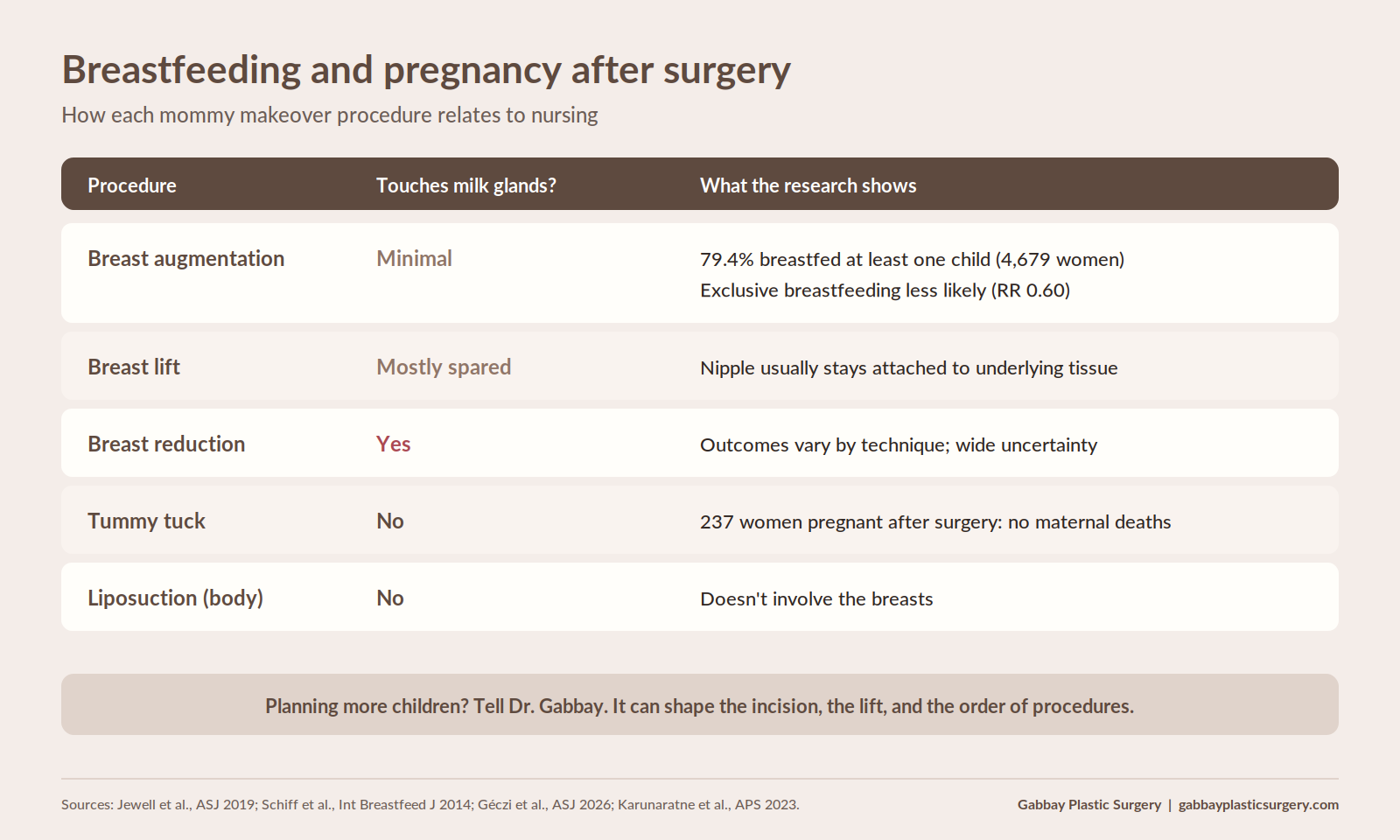 Procedure-by-procedure panel: augmentation, lift, reduction, tummy tuck, liposuction, showing what each touches and the key research figures.
If you may have more children: a planning guide
Procedure | Effect on future breastfeeding | Effect of a future pregnancy on the result | Common approach if more children are possible |
|---|---|---|---|
Breast augmentation | Most women breastfeed; exclusive breastfeeding may be less likely | Breasts may change in size and shape again | Often reasonable now, with an incision in the breast crease |
Breast lift | Usually preserved when the nipple stays attached to underlying tissue | Some sagging may return | Many women wait, but it can be done now if the concern is significant |
Breast reduction | Greater potential impact, depending on technique | Some change possible | Discuss technique choices that protect function |
Tummy tuck | None | Skin and muscle may stretch again | Usually best after your family is complete |
Liposuction | None | Fat distribution may change with weight gain | Often reasonable now |
This isn't a rule book. Some women decide the benefit of doing a procedure now outweighs the chance of a future touch-up. The point is to make that choice knowingly.
Timing your surgery around nursing
If you're currently breastfeeding, most surgeons recommend waiting until you've weaned and your breasts have settled, often at least three to six months, before breast surgery. This lets your breast size and shape stabilize, which makes planning more accurate. See When Is the Best Time to Get a Mommy Makeover? for a detailed timeline.
If you do breastfeed after surgery
A few practical steps help:
Let your obstetrician, pediatrician, and a lactation consultant know about your surgery early in pregnancy.
Watch your baby's weight gain and diaper counts in the first weeks, as you would with any newborn.
Ask for help early if supply seems low. Many women with surgery combine breastfeeding with supplementation when needed, and any amount of breast milk has value.
Keep up with your normal breast imaging, and let your radiologist know you have implants.
Your priorities guide the plan
As Dr. Gabbay reminds patients, "the decision is yours and yours alone." If breastfeeding a future child matters to you, say so at your consultation. It may shape the incision, the implant placement, the type of lift, and the order of your procedures.
Frequently asked questions
Can you breastfeed with breast implants?
Most women can. In a large registry, about 79% of women who gave birth after augmentation breastfed at least one child. Rates of exclusive breastfeeding may be somewhat lower.
Which breast implant incision is best for breastfeeding?
Many surgeons prefer the crease under the breast because it avoids cutting through breast tissue near the nipple. In the largest registry, incision location didn't significantly change outcomes.
Does implant placement over or under the muscle matter for breastfeeding?
Registry data found lactation outcomes were similar regardless of placement.
Can I breastfeed after a breast lift?
Many women can, especially when the nipple remains attached to the tissue beneath it, as it does in most lifts.
Is it safe to get pregnant after a tummy tuck?
Yes. A systematic review of 237 pregnancies after tummy tuck found no maternal or newborn deaths. Pregnancy may stretch the skin and muscles again, which is why waiting until you're done having children gives the most lasting result.
Does liposuction affect breastfeeding?
Liposuction of the abdomen, flanks, or other body areas doesn't involve the breasts.
How long after breastfeeding should I wait for breast surgery?
Usually at least three to six months after weaning, once your breasts have stabilized.
Plan around your family
Whether your family is complete or you're keeping options open, Dr. Gabbay can design a plan that fits. Schedule a consultation at 9454 Wilshire Blvd, Suite 710, Beverly Hills, or call (310) 205-9500. You can also browse mommy makeover results.
Sources
Jewell ML, et al. Lactation Outcomes in More Than 3500 Women Following Primary Augmentation: 5-Year Data From the Breast Implant Follow-Up Study. Aesthetic Surgery Journal. 2019;39(8):875–883.
Schiff M, et al. The impact of cosmetic breast implants on breastfeeding: a systematic review and meta-analysis. International Breastfeeding Journal. 2014;9:17.
Géczi AM, et al. Impact of Breast Augmentation, Reduction, and Nipple Repair on Breastfeeding Success: A Systematic Review and Meta-analysis. Aesthetic Surgery Journal. 2026.
Karunaratne YG, et al. The Safety and Effects of Pregnancy after Abdominoplasty: A Systematic Review of the Literature. Aesthetic Plastic Surgery. 2023.
American Society of Plastic Surgeons. Tummy Tuck.
This article is for educational purposes and isn't a substitute for an individual medical evaluation or lactation advice. Individual results vary.