
Breast Lift Without Implants: Adding Volume With Your Own Tissue or Fat
Jump To Section
A breast lift can put your breasts back where they were before pregnancy. What it can't do on its own is bring back the fullness that nursing took away, especially in the upper part of the breast. The American Society of Plastic Surgeons notes that a breast lift "does not significantly change the size of your breasts or round out the upper part of your breast."
That's why so many moms ask whether a breast lift without implants can still look full. Often it can. There are three ways to add volume during a lift, and two of them use no implant at all: reshaping your own breast tissue, transferring your own fat, or placing an implant. Dr. Joubin Gabbay, a board-certified plastic surgeon in Beverly Hills, treats all three as parts of what he calls a whole-breast approach, and he walks through them in this breast lift video. Each option suits a different goal.
Key takeaways
Auto-augmentation uses breast tissue that would otherwise be removed to rebuild the upper breast. It adds shape and fullness but not much size.
Fat transfer adds modest, natural-feeling volume. On average, about 60% of the transferred fat remains at one year, and more than one session may be needed.
An implant is the only option that reliably adds significant, predictable volume.
These options can be combined. Many women do best with a lift plus a small implant or a lift plus fat.
The right choice depends on how much fullness you want, how much tissue you have, and how you feel about implants.
Why the lift alone can leave the upper breast flat
After pregnancy and breastfeeding, the breast gland often shrinks and the skin stretches. The remaining tissue settles low. A lift removes extra skin and repositions the tissue higher on the chest, which restores shape and projection. But if there's simply less tissue than there used to be, the upper breast can still look flat after the lift.
How much that matters is personal. Some women are thrilled with a lift alone. Others want the fullness they had before, or more. The options below help close that gap.
For help deciding whether you need a lift at all, see Mommy Makeover: Breast Lift vs. Implants. To understand how the lift itself is designed, read Breast Lift Scars: What Each Incision Pattern Leaves Behind.
Who does well with a breast lift without implants?
A lift without implants tends to suit you if:
You liked your breast size before pregnancy and mainly want lift and shape back.
You still have a fair amount of breast tissue, even if it sits low.
You'd rather avoid implant upkeep or future implant surgery.
You're happy with a modest gain in fullness rather than a bigger cup size.
If you want to be noticeably larger than before kids, a lift with implants is usually the better match. The sections below explain each option.
Option 1: Auto-augmentation (your own breast tissue)
In a standard lift, some tissue from the lower breast is removed along with extra skin. In an auto-augmentation, that tissue is kept. It's shaped into a flap that stays attached to its blood supply, then tucked up beneath the upper breast to add fullness where the breast looks empty.
What it does well
Fills out the upper breast using tissue you already have.
No implant, so no implant maintenance or future replacement.
Creates a natural, soft result that ages with you.
What it can't do
It moves volume rather than adding it. The overall cup size stays about the same.
It works best for women who still have a reasonable amount of breast tissue in the lower breast.
What the research shows In a series of 53 patients (107 breasts) who had auto-augmentation with an inferior pedicle flap, nipple elevation averaged 8 cm. About 94.3% of patients healed without complications, and 5.7% had further procedures because they wanted a different level of lift (Kirwan, Archives of Plastic Surgery).
Auto-augmentation typically takes one to two hours under general anesthesia.
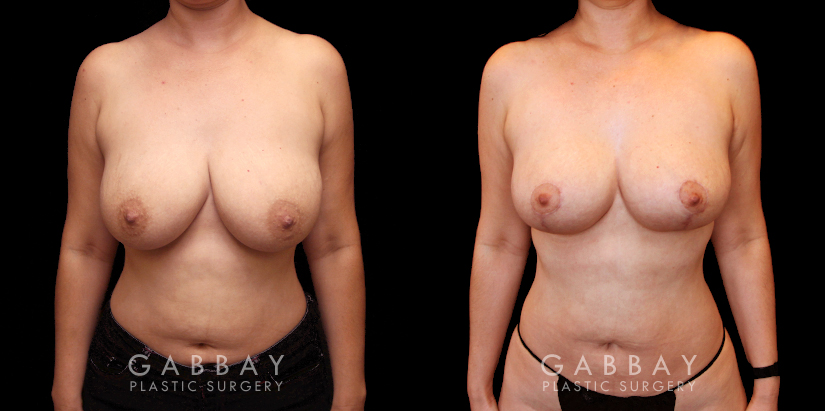 Breast lift with auto-augmentation by Dr. Joubin Gabbay. Individual results vary.
Option 2: Fat transfer (your own fat)
With fat transfer, fat is removed by liposuction from an area such as the abdomen or flanks, purified, and injected in small amounts into the breast. For moms, it has a bonus: the donor area gets slimmer at the same time.
Dr. Gabbay has published research on fat-derived stem cells, so this is familiar ground. It's also where honest expectations matter most. As he puts it, "Fat transfer to the breasts will not give you the look of breast implants." If you want more volume, it may take a few rounds, and results are improving but still modest. This short video on fat transfer to the breasts covers what to expect.
What it does well
Adds soft, natural-feeling volume with no implant.
Improves contour in the upper breast and cleavage area.
Slims the areas where fat is taken.
What it can't do
Add large amounts of volume in a single session.
Guarantee exactly how much will last. Some transferred fat is always reabsorbed.
What the research shows A 2026 meta-analysis of 40 studies and 5,684 patients found an average volume retention of 61.3% at 12 months and patient satisfaction of 93.1%. The pooled complication rate was 25.9%, which includes minor issues such as small oil cysts and firm areas of fat that don't survive (Gentile et al., Aesthetic Surgery Journal). Surgeons reduce these risks by injecting small amounts in many layers rather than large amounts in one area.
Fat transfer needs donor fat, so very slim women may not have enough to reach their goal. If you plan to have fat transferred, tell your radiologist at future mammograms; modern imaging can generally tell the difference between grafted fat and other changes.
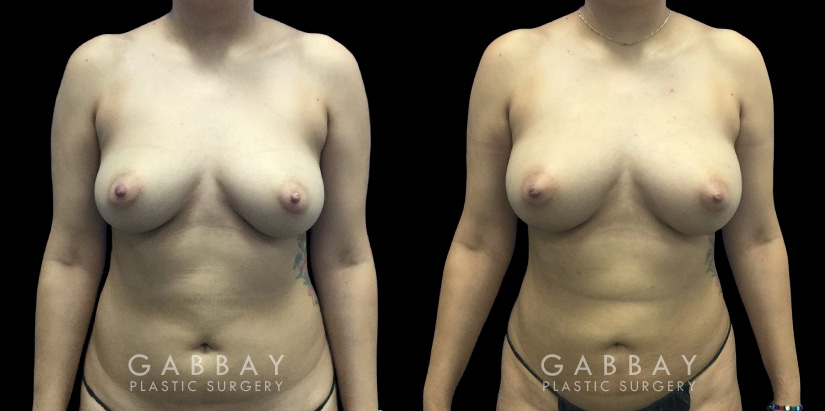 Breast fat grafting by Dr. Joubin Gabbay. Individual results vary.
Option 3: An implant
If you want significant fullness, an implant is the most reliable choice. Fat and your own tissue can refine a shape. Real, noticeable fullness takes an implant.
What it does well
Adds predictable volume you can see at your consultation using sizers.
Creates upper-breast fullness that doesn't depend on fat survival.
Can be combined with a lift in one operation for many patients.
What to consider
Implants aren't lifetime devices. The FDA notes that additional surgeries may be needed over time.
A larger implant adds weight, which can work against the lift. With a lift, a modest implant is often the better choice.
What the research shows A systematic review of 4,856 single-stage lift-with-implant procedures found a pooled complication rate of 13.1%, a reoperation rate of 10.7%, and recurrent sagging in 5.2% (Systematic review, Plastic and Reconstructive Surgery).
Dr. Gabbay uses silicone implants almost exclusively, prefers an incision in the breast crease, and brings implant sizers into surgery so the final choice matches your frame. "I hate surprises in surgery," he says. His Breast Augmentation 101 video covers each of those choices. He performs breast augmentation with a lift as a single operation when it's appropriate.
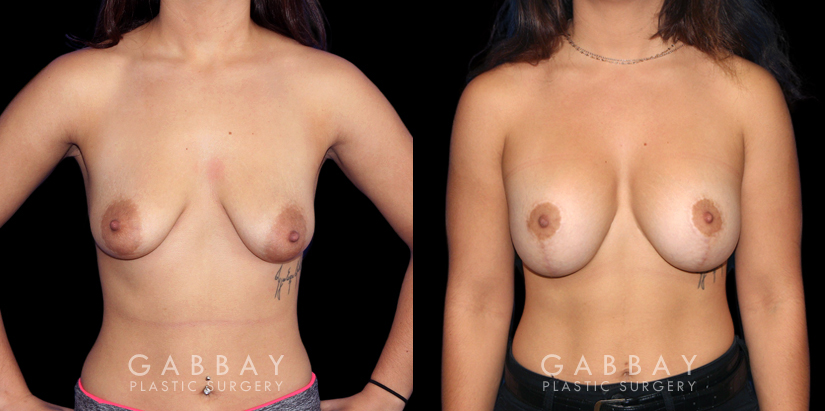 Breast augmentation with lift by Dr. Joubin Gabbay. Individual results vary.
Side-by-side comparison
Auto-augmentation | Fat transfer | Implant | |
|---|---|---|---|
Source of volume | Your own breast tissue, repositioned | Your own fat from another area | Silicone implant |
Adds overall size? | Minimal | Modest | Yes, predictably |
Upper-breast fullness | Improved | Improved | Most noticeable |
Sessions | One | May need more than one | One |
Long-term maintenance | None specific | None specific | Implants may need replacement over time |
Best for | Enough breast tissue, wants shape, not size | Wants a small boost, has donor fat | Wants noticeable fullness |
Combining approaches
These options aren't mutually exclusive. Some combinations Dr. Gabbay may discuss:
Lift with auto-augmentation plus fat. Your own tissue rebuilds the upper breast, and fat adds a modest boost and softens the transition.
Lift with a small implant plus fat. A smaller implant keeps weight down, and fat is used to smooth the edges, which is helpful when the tissue over the implant is thin. A systematic review of this "composite" approach found an average of about 109 ml of fat per breast was used alongside the implant, with a pooled reoperation rate of 3.7% (Salibian et al., Plastic and Reconstructive Surgery Global Open).
Lift now, volume later. Some women prefer to see how they feel after a lift before deciding on more.
How to decide
Ask yourself three questions:
How much fuller do I want to be? If the answer is "about what I was before kids," auto-augmentation or fat may be enough. If it's "noticeably fuller," an implant is usually the answer.
How do I feel about implants? If you'd rather avoid them, focus on auto-augmentation and fat, and keep your expectations realistic about size.
Am I planning more pregnancies? Breast surgery can be done if you're planning another pregnancy, including as part of a mommy makeover. Future pregnancy and breastfeeding can still change your result. Read Can You Breastfeed After a Breast Lift, Implants, or Mommy Makeover?
In a mommy makeover, the breast plan is one piece of the whole. If your list is long, How to Prioritize a Mommy Makeover can help you decide what to do first.
Frequently asked questions
Can I get a fuller breast lift without implants?
Yes, for many women. Auto-augmentation uses your own breast tissue to fill the upper breast, and fat transfer adds modest volume. Neither adds as much volume as an implant.
How much bigger will fat transfer make my breasts?
Usually a modest change, often described as a partial cup size per session. On average, about 60% of transferred fat remains at one year. More than one session may be needed for your goal.
What is breast auto-augmentation?
A breast lift technique that repositions tissue from the lower breast to the upper breast instead of removing it, creating fullness without an implant.
Is it safe to do a lift and implants at the same time?
For appropriately selected patients, yes. A review of nearly 5,000 cases found a reoperation rate of about 11%. Dr. Gabbay will tell you whether one stage or two is safer for your tissue.
Do I need a lift or just implants?
If your nipples sit at or below the breast crease, an implant alone usually won't correct the sagging. See Mommy Makeover: Breast Lift vs. Implants.
Which option looks most natural?
All three can look natural when planned well. Auto-augmentation and fat use your own tissue. With implants, choosing a size that fits your frame is key.
Find the right balance of shape and volume
Dr. Gabbay will examine your tissue, show you realistic options, and help you choose the approach that matches your goals. Schedule a consultation at 9454 Wilshire Blvd, Suite 710, Beverly Hills, or call (310) 205-9500. You can also browse our breast lift with implant results.
Sources
American Society of Plastic Surgeons. Breast Lift.
Kirwan L. Breast Auto-Augmentation: A Versatile Method of Breast Rehabilitation. A Retrospective Series of 107 Procedures. Archives of Plastic Surgery. 2015.
Gentile P, et al. Autologous Fat Grafting for Breast Augmentation and Breast Remodeling: A Systematic Review and Meta-analysis. Aesthetic Surgery Journal. 2026.
Salibian AA, et al. Fat Grafting and Breast Augmentation: A Systematic Review of Primary Composite Augmentation. Plastic and Reconstructive Surgery Global Open. 2019.
A Systematic Review of Single-Stage Augmentation-Mastopexy. Plastic and Reconstructive Surgery. 2014.
U.S. Food and Drug Administration. Things to Consider Before Getting Breast Implants.
This article is for educational purposes and isn't a substitute for an individual medical evaluation. Individual results vary.