
Your Belly Button After a Tummy Tuck: How It's Designed
Jump To Section
When women look at tummy tuck before-and-after photos, they often notice the flat stomach first and the belly button second. That's natural. But the belly button is frequently what makes a result look natural or obviously "done." A navel that's too round, too large, or surrounded by a visible ring of scar can draw attention to itself, even when the rest of the abdomen looks great.
Pregnancy changes the belly button as much as the rest of the abdomen. Many moms notice that it has become stretched, widened, hooded, or pushed outward. A tummy tuck can change that. It's a chance to restore a small, natural-looking navel. This guide explains how Dr. Joubin Gabbay, a board-certified plastic surgeon in Beverly Hills, approaches that part of the operation.
Key takeaways
Your belly button isn't removed or moved in a full tummy tuck. It stays attached to the abdominal wall while the skin around it is pulled down, and a new opening is created for it.
Research on hundreds of participants favors a small, vertically oriented, oval or T-shaped navel with a slight hood of skin at the top.
In women, the most appealing belly buttons are about 1.4 times taller than they are wide.
Narrowing of the new navel is uncommon and can usually be prevented with careful design and aftercare.
In a mini tummy tuck, the belly button is usually left in its original position.
What happens to your belly button during a tummy tuck
Here's the part most people get wrong. Your belly button is connected by a stalk of tissue to the abdominal wall. During a full tummy tuck:
An incision is made around the belly button so it stays attached to the abdominal wall on its stalk.
The abdominal skin and fat are lifted off the muscles, and the muscles are repaired if needed.
The skin is pulled down toward the lower incision, and the excess is removed.
A new opening is made in the skin at the right height, and the belly button is brought through and stitched into place.
So the belly button itself stays where it was on your body. What changes is the skin around it. That's why the opening's shape, size, and scar placement matter so much. The surgeon is designing a new frame for it.
For more on the muscle repair in step two, see Does Every Tummy Tuck Include Muscle Repair?
What makes a belly button look natural
It turns out that people broadly agree on what looks attractive, and researchers have studied it.
In a classic study published in Plastic and Reconstructive Surgery, 147 women rated photos of different navels, and small belly buttons were consistently preferred (Craig et al., Plastic and Reconstructive Surgery; summarized in Fell et al., ePlasty).
A 2023 review of 16 studies and 1,263 participants reached similar conclusions. The optimal navel was reported as small, vertically oriented, and T- or oval-shaped with a superior hood. In women, the average ratio of height to width was 1.40, compared with 0.88 in men, so a naturally feminine navel is noticeably taller than it is wide (Fell et al., ePlasty). The authors also noted that it should be large enough for easy hygiene.
A review in Aesthetic Surgery Journal summed it up the same way: an attractive umbilicus is "small, vertically oriented, and linear or oval in shape" (Aesthetic Surgery Journal). It also noted that pregnancy, weight changes, and aging often make the navel look horizontal, stretched, or "sad."
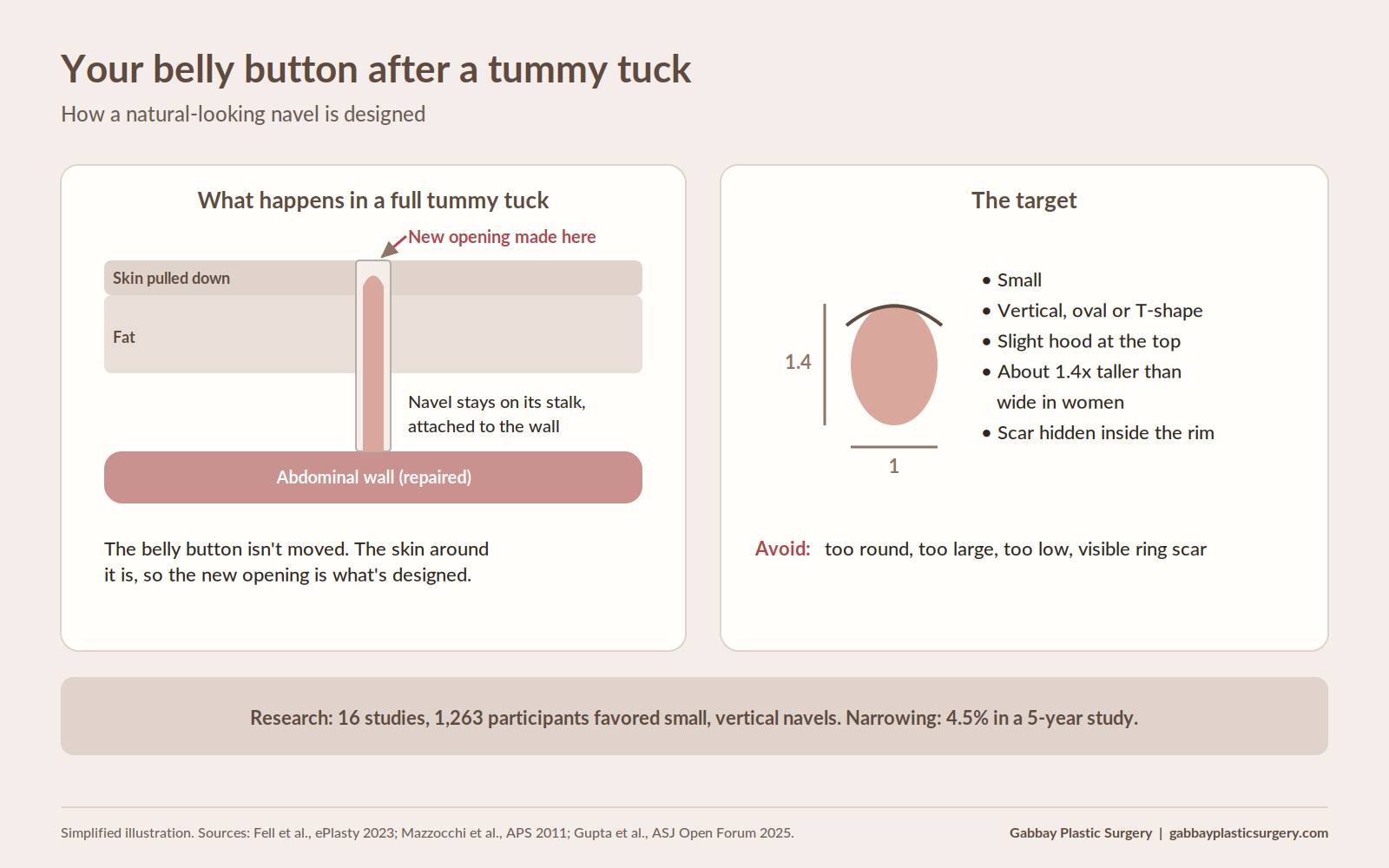 Diagram showing the belly button on its stalk, the new skin opening, and the target proportions: small, vertical, about 1.4 times taller than wide, with a superior hood. Includes common results to avoid (too round, too large, visible ring scar).
The design decisions
Several choices shape how your belly button will look.
Position. The belly button generally stays at its natural height. Surgeons check the new opening against landmarks such as the hip bones and the midpoint between the bottom of the breastbone and the pubic bone. A navel that's placed too low is one of the tell-tale signs of an overdone tummy tuck.
Size. Smaller usually looks better, but not so small that it narrows. The review above reported attractive sizes ranging from about 0.6 to 3.0 cm (Fell et al., ePlasty).
Shape of the opening. A round opening tends to heal as a round, ring-like scar. Many surgeons use a vertical oval, a small inverted V, or a similar shape that creates the vertical, slightly hooded appearance people prefer.
Depth. A natural belly button sits in a gentle hollow. Securing the stalk to the muscle layer and thinning the fat just around the opening helps create that inset look.
Scar placement. The goal is to hide the scar inside the rim of the navel, where it's barely visible once healed.
A recent technique guide in Aesthetic Surgery Journal Open Forum described one such approach in 223 abdominoplasty patients: the navel was placed at the midpoint between the breastbone and the pubic bone, a small crescent of skin was removed to create a hood, and the stalk was anchored to the abdominal wall. Silicone plugs were used for six weeks after surgery. There were no cases of narrowing or tissue loss, and 72.6% of patients were highly satisfied (Gupta et al., Aesthetic Surgery Journal Open Forum).
 Tummy tuck by Dr. Joubin Gabbay. Individual results vary.
Full tummy tuck vs. mini tummy tuck
Full tummy tuck | Mini tummy tuck | |
|---|---|---|
Belly button | Brought through a new opening | Usually left in place, no new opening |
Belly button scar | Small scar inside the rim | Usually none |
Belly button shape | Can be redesigned | Mostly unchanged |
With a mini tummy tuck, the skin below the navel is tightened, but the belly button itself usually isn't touched. If your navel has been stretched or hooded by pregnancy, a full tummy tuck is typically the way to improve it. You can compare both on our tummy tuck overview.
 Mini tummy tuck by Dr. Joubin Gabbay. Individual results vary.
Common belly button concerns after pregnancy
Pregnancy can leave the navel with specific issues that a tummy tuck can address:
An "outie" or bulge. Sometimes this is a small umbilical hernia. If so, it can often be repaired during the tummy tuck. See Common Belly Button Problems for more on hernias.
A stretched or horizontal navel. The new opening can restore a vertical shape.
Heavy hooding. Excess skin above the navel is removed as part of the tummy tuck.
A stretched piercing hole. An old piercing can often be removed or repaired. Dr. Gabbay also performs belly button hole repair as a separate procedure.
 Belly button piercing repair by Dr. Joubin Gabbay. Individual results vary.
Belly button piercings and a tummy tuck
Many women have a navel piercing, or had one years ago. Here's how it fits in.
Before surgery. Take out all navel jewelry before your tummy tuck. Tell Dr. Gabbay about any current or old piercing at your consultation so he can plan around it.
Old piercing holes. A stretched or scarred piercing hole can often be repaired during the tummy tuck, as part of shaping the new belly button. Sometimes the old hole sits in skin that is removed anyway.
Piercing after a tummy tuck. Wait until your belly button has fully healed and Dr. Gabbay clears you. Piercing too soon can raise the risk of infection or a widened scar. A new piercing should go through healed tissue, not fresh scar.
Not having a tummy tuck? If you only want an old piercing hole closed, that's a small procedure on its own. Dr. Gabbay usually does belly button hole repair with local numbing, and stitches come out in about a week.
How your belly button heals
The belly button often takes a little longer to settle than the rest of the abdomen.
First two weeks. The navel is usually covered with a small dressing. Some scabbing, swelling, or crusting at the edges is normal.
Weeks two to six. Swelling improves and the shape becomes clearer. Some surgeons use a small plug or soft packing to help keep the opening from narrowing.
Months three to twelve. The scar inside the rim softens and fades, and the final shape emerges.
Your care instructions will include how to clean the area. It's normal for the navel to look a bit swollen or uneven early on.
For overall recovery, see Tummy Tuck Recovery: What to Expect in Week 1.
How the belly button and the lower scar work together
The belly button and the tummy tuck scar are planned as a pair. The more skin that needs to be removed, the more the skin above the navel is pulled downward, and the navel's old opening is often removed entirely with the excess skin. That's also why the new opening's position has to be marked carefully: if the skin between the navel and the lower incision is stretched too far, the navel can end up too low or the lower scar can ride up. Dr. Gabbay plans both at the same time so the navel sits at a natural height and the lower scar stays low enough to hide under underwear or a swimsuit. For more on the lower scar, see Tummy Tuck Scar Placement.
What to tell your surgeon
If you've ever had a bulge at your navel, especially one that gets bigger when you cough or strain.
If you have or had a navel piercing.
Any photos of belly buttons you like, including your own before pregnancy.
Any history of slow-healing scars or thick scars.
Possible issues and how they're managed
Belly button complications are uncommon, and most are minor.
Narrowing (stenosis). The opening can tighten as it heals. In a five-year study of 111 tummy tucks using a vertical-ellipse technique, narrowing occurred in 4.5%, and the navel's shape and appearance were stable at five years (Mazzocchi et al., Aesthetic Plastic Surgery). Design choices and plugs during healing help prevent it.
Slow healing at the edges. Small areas of delayed healing can occur and usually resolve with wound care.
Visible scarring. Scar hidden inside the rim typically fades well. Smoking and tension raise the risk of wider scars.
If a belly button doesn't heal as expected, a minor revision can usually correct it.
Frequently asked questions
Can I get a belly ring after a tummy tuck?
Yes, for most women, once the belly button has fully healed and your surgeon clears you. Don't wear navel jewelry in the weeks after surgery. Plan to pierce healed tissue, not the fresh scar.
Do you get a new belly button with a tummy tuck?
Not exactly. Your original belly button stays attached to the abdominal wall. A new opening is made in the skin, and the belly button is brought through it.
Can I choose the shape of my belly button?
You can share your preferences, and Dr. Gabbay will design the opening to create a natural, proportional shape. The final look also depends on your anatomy and healing.
Will my belly button look fake after a tummy tuck?
It shouldn't. A small, vertical opening with a slight hood and a scar hidden inside the rim generally looks natural.
Does a mini tummy tuck change the belly button?
Usually not. In a mini tummy tuck, the belly button typically stays as it is.
Can an umbilical hernia be fixed during a tummy tuck?
Often, yes. Let Dr. Gabbay know if you've noticed a bulge at your belly button so it can be evaluated.
How long does it take for the belly button to heal?
Most of the healing happens in the first six weeks. The scar keeps softening for up to a year.
A natural result, down to the details
The belly button is small, but it's one of the details that separates a good tummy tuck from a great one. Schedule a consultation with Dr. Gabbay at 9454 Wilshire Blvd, Suite 710, Beverly Hills, or call (310) 205-9500. You can also view tummy tuck results.
Sources
Craig SB, Faller MS, Puckett CL. In search of the ideal female umbilicus. Plastic and Reconstructive Surgery. 2000;105(1):389–392.
Fell C, et al. Does Size Really Matter? A Review on How to Determine the Optimal Umbilical Size During an Abdominoplasty. ePlasty. 2023.
Restoration Liposuction of the Abdomen. Aesthetic Surgery Journal. 2023;43(6):NP413.
Gupta R, et al. Improving Umbilical Aesthetics in Abdominoplasty Surgery: A Step-by-Step Technique Guide. Aesthetic Surgery Journal Open Forum. 2025.
Mazzocchi M, et al. Long-Term Results of a Versatile Technique for Umbilicoplasty in Abdominoplasty. Aesthetic Plastic Surgery. 2011.
This article is for educational purposes and isn't a substitute for an individual medical evaluation. Individual results vary.