
Does Every Tummy Tuck Include Muscle Repair? A Surgeon Explains
Jump To Section
If you've had children and still can't flatten the area around your belly button no matter how much you train, you've probably come across the term diastasis recti. It's also the reason so many moms ask the same question during a consultation: "Will my tummy tuck actually fix the muscles, or just remove skin?"
In a classic tummy tuck, yes. Muscle repair is part of the operation, and Dr. Joubin Gabbay, a board-certified plastic surgeon in Beverly Hills, covers the basics in this short video on tummy tuck muscle repair. The longer answer, and the one that matters for your result, covers how much of the muscle wall is repaired, how the repair is done, and what it can and can't change.
Key takeaways
Some separation of the abdominal muscles after pregnancy is extremely common. In a study of 300 first-time mothers, 60% had it at six weeks postpartum and about a third still had it at one year.
A full tummy tuck typically repairs the muscle wall from the ribs to the pubic bone. A mini tummy tuck usually addresses only the area below the belly button, if at all.
Modern repairs are durable. One recent series of 71 patients found no recurrence at an average follow-up of 21 months.
Beyond appearance, research links muscle repair to meaningful improvement in low back pain and bladder leakage.
Exercise builds core strength and is worth doing either way, but it rarely closes a wide gap on its own.
Diastasis is a normal change
During pregnancy, the two vertical "six-pack" muscles (the rectus abdominis) stretch apart to make room for the baby. The band of connective tissue between them, called the linea alba, thins and widens. After delivery, that band often doesn't fully tighten back up.
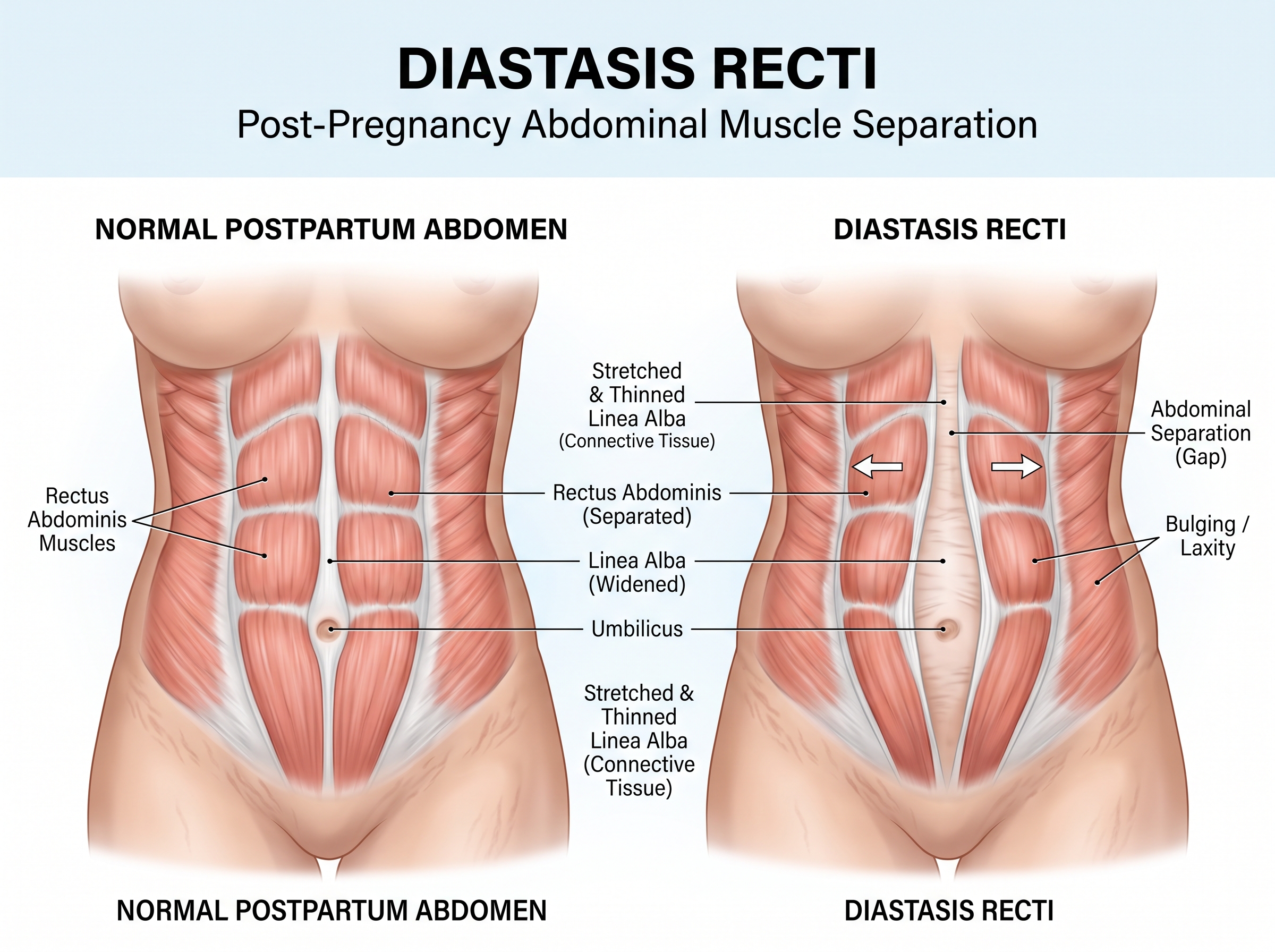
So let's be clear about one thing. This is a normal part of having children, not a disease, and nothing to feel embarrassed about. As Dr. Gabbay puts it, "Every single woman who has ever had a child in the history of the world has some degree of diastasis recti."
The research shows just how common it is. A prospective study of 300 first-time pregnant women in Norway found diastasis in 33.1% at 21 weeks of pregnancy, 60.0% at six weeks postpartum, about 45% at six months, and 32.6% at 12 months (Sperstad et al., British Journal of Sports Medicine). In other words, many women improve naturally during the first year, and many don't. Having more than one pregnancy, carrying multiples, or carrying a large baby tends to stretch the wall further.
What you notice in the mirror is usually a mix of three layers: skin, fat, and muscle. Loose skin creates the fold or crepey texture. Stubborn fat adds fullness. A widened muscle wall pushes everything forward, which is why many moms say they "still look pregnant" by the end of the day even when they're close to their goal weight.
How the muscle repair actually works
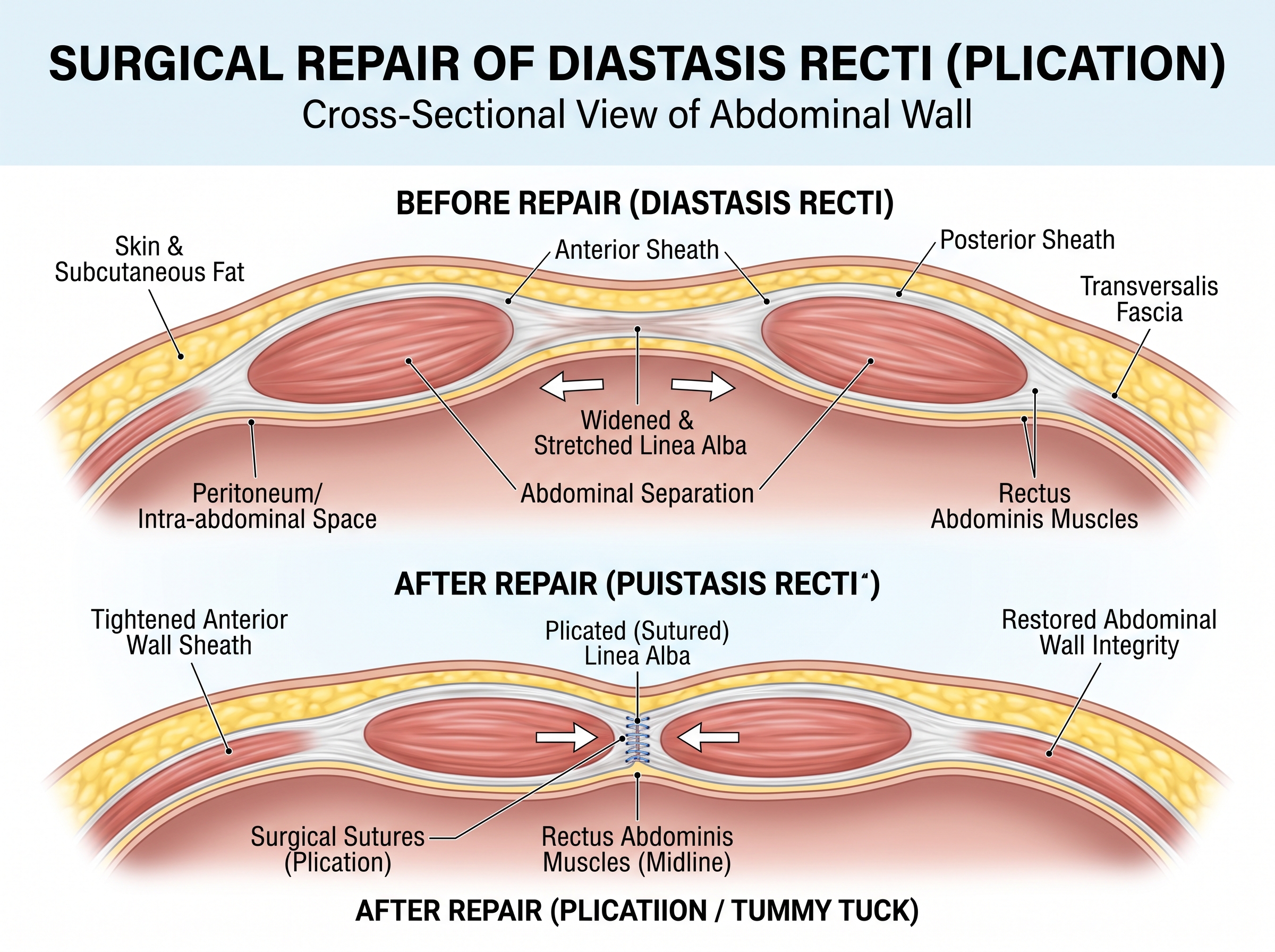
In a tummy tuck, the repair is called rectus plication. After the skin and fat are lifted off the abdominal wall, the surgeon brings the two rectus muscles back toward the midline by stitching together the firm outer sheath (fascia) that surrounds them. In plain terms, the two six-pack muscles get sewn back together. Closing that gap flattens the stomach and brings in the waist, and it can improve core strength too. Dr. Gabbay explains the repair in this short video on skin, fat and muscle after pregnancy, if you'd like to see it.
A few details affect how this translates into your result:
Length of the repair. A full repair runs from just below the breastbone to the pubic bone, which flattens both the upper and lower abdomen and narrows the waist.
Layers. Many surgeons use two layers of sutures, one set of interrupted stitches for strength and a running layer to smooth the line.
Suture type. Both permanent and long-lasting absorbable sutures are used. The repair relies on the fascia healing together in its new position, not only on the stitch.
That last point surprises many patients, so it's worth a closer look. A 2024 study in Aesthetic Surgery Journal Open Forum followed 71 women who had a double-layer plication with absorbable sutures, which are fully absorbed by about 120 days. At an average follow-up of 21.1 months, the researchers found 0% diastasis recurrence and 0% revision for the repair (Jackson et al., Aesthetic Surgery Journal Open Forum). Earlier work measuring the abdominal wall years after surgery has also found that plication generally holds when patients maintain a stable weight and don't have another pregnancy (Journal of Plastic, Reconstructive and Aesthetic Surgery).
Full tummy tuck vs. mini tummy tuck: how much muscle gets repaired
This is where "the classic answer is yes" needs a closer look.
Full tummy tuck | Mini tummy tuck | |
|---|---|---|
Skin removed | Lower abdomen, from hip to hip | A smaller segment below the belly button |
Belly button | Repositioned through a new opening | Usually left in place |
Muscle repair | Typically the full length, ribs to pubic bone | If performed, usually limited to below the belly button |
Best for | Separation above and below the navel, moderate to significant loose skin | Mild lower-belly laxity with minimal upper separation |
A full tummy tuck generally takes two to five hours, and most patients plan about 14 days away from work.
Most moms who've carried a pregnancy to term have some separation above the belly button as well as below it. That's one reason a mini tummy tuck is a narrower option than many people expect. If your main complaint is a pooch that pushes out above and below the navel, a limited repair may leave the upper abdomen unchanged. During your exam, Dr. Gabbay checks the full length of the midline, often while you lift your head and shoulders, to see where the wall is weak.
There are also patients who need little or no muscle repair, typically those whose main concern is loose skin rather than a protruding wall. The American Society of Plastic Surgeons describes tummy tuck surgery as removing excess fat and skin and, "in most cases," restoring weakened or separated muscles. The plan follows your anatomy, not a template.
 Full tummy tuck by Dr. Gabbay
 Mini tummy tuck by Dr. Gabbay
Benefits beyond a flatter stomach
Muscle repair is primarily an aesthetic operation, but a growing body of research suggests it can help how you feel as well as how you look.
The most cited study enrolled 214 postpartum women across nine plastic surgery centers. Their average muscle separation was 4.5 cm. After abdominoplasty with rectus repair, the average Oswestry low back pain disability score dropped from 21.6% before surgery to 3.2% at six months, and the average urinary incontinence score fell from 6.5 to 1.6 (Taylor et al., Plastic and Reconstructive Surgery). The authors concluded that abdominoplasty with rectus repair "creates a significant improvement in the functional symptoms of low back pain and urinary incontinence."
A review of treatment options for rectus diastasis reached a similar conclusion: recurrence and complication rates are low, and repair improves back pain, incontinence, and quality of life (Treatment Options for Abdominal Rectus Diastasis, PMC).
These results don't necessarily mean that a tummy tuck is a treatment for back pain, and not every patient notices a change. But if you've felt that your core hasn't worked properly since your last pregnancy, it's worth mentioning during your consultation.
Can exercise fix diastasis on its own?
Physical therapy, Pilates, and yoga are worth doing after pregnancy whether or not you ever have surgery. A strong core supports your back, your posture, and your recovery if you do choose surgery later.
What the research shows is that exercise helps, but the effect on the gap itself is modest. A 2025 meta-analysis of 34 randomized trials and 1,548 postpartum women found that abdominal exercise narrowed the inter-rectus distance by an average of about 6.8 mm compared with no intervention, with evidence certainty rated very low to moderate (de Oliveira et al., Medicine). For a woman with a 4 to 5 cm separation like the average patient in the functional study above, that's a small fraction of the gap.
A practical way to think about it:
Give your body time. Many women improve during the first year, so most surgeons prefer to wait until you're at least several months past pregnancy and breastfeeding.
Train for function. Core and pelvic floor work is valuable at every stage, and a pelvic floor physical therapist can guide you safely.
Consider surgery for structure. If a firm, stable workout routine hasn't changed a visible bulge after a year or more, the issue is usually stretched fascia and skin, which exercise can't shorten.
What muscle repair can't change
Setting the right expectations is part of a good result.
Fat behind the muscle. Plication tightens the wall in front of your organs. It can't reduce fat stored inside the abdomen, which is why being close to a stable weight matters. Ideally, you're within about 15 to 20 pounds of your goal weight before surgery. For more on this, see Tummy Tuck Candidacy and Weight Requirements.
Stretch marks above the removed skin. The ASPS notes that a tummy tuck can't correct stretch marks, although those on the skin that's removed will be gone (American Society of Plastic Surgeons).
Future pregnancies. Another pregnancy can stretch the repair again. The ASPS advises women planning more children to postpone a tummy tuck (American Society of Plastic Surgeons).
What muscle repair means for recovery
The repair is the part of a tummy tuck you'll feel most. A tightened wall makes the first week feel snug, especially when you sit up or cough, and most patients walk slightly bent forward for several days. That's normal and it improves quickly. Dr. Gabbay's patients are encouraged to walk the day after surgery, avoid strenuous activity for about four weeks, and avoid driving for about two weeks (Gabbay Plastic Surgery).
For a day-by-day look, read Tummy Tuck Recovery: What to Expect in Week 1. If you're interested in avoiding drains, see Are You a Candidate for a Drainless Tummy Tuck?.
Muscle repair in a mommy makeover
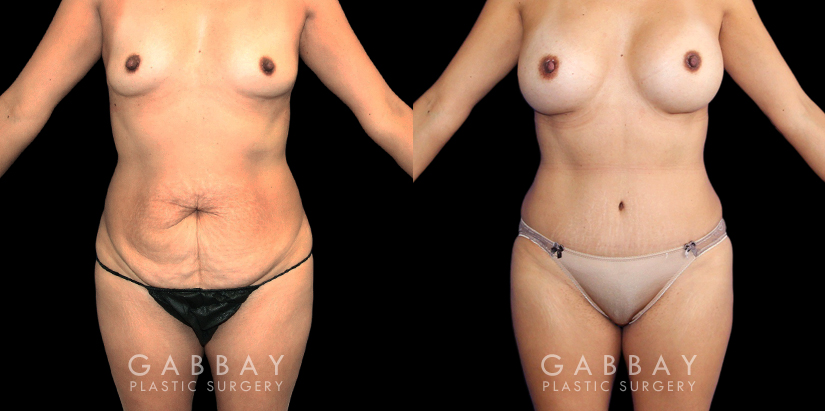
In a mommy makeover, the tummy tuck and its muscle repair are usually the foundation, and breast surgery and targeted liposuction are built around them. A mommy makeover is simply two or more procedures that address the changes that came with having kids. Dr. Gabbay explains how he plans one in this video. A combined mommy makeover typically takes three to six hours, with full recovery in about six weeks.
A tightened midline also changes how the waist looks. Once the wall is flat, conservative liposuction along the flanks usually has a bigger visual effect than it would on its own. If you're weighing how much to include, How Much Liposuction Can Be Done During a Tummy Tuck? explains the limits.
 Mommy Makeover by Dr .Gabbay
Frequently asked questions
Does every tummy tuck include muscle repair?
Most do. A full tummy tuck typically repairs the muscle wall from the ribs to the pubic bone. A mini tummy tuck may include a limited repair below the belly button or none at all, and a small number of patients with mostly skin laxity don't need a repair.
How do I know if I have diastasis recti?
A common sign is a ridge or dome along the midline when you lift your head from a lying position, or a belly that pushes out even when you're lean. A surgeon or physical therapist can measure the gap during an exam.
Can diastasis come back after a tummy tuck?
Recurrence is uncommon with modern techniques. One 2024 series of 71 patients reported no recurrence at an average of 21 months. Significant weight gain or another pregnancy can stretch the repair.
Is muscle repair more painful?
It's the main source of tightness after a tummy tuck, especially in the first week. Pain is managed with medication, and most patients describe it as pressure and tightness that improves steadily.
Will insurance cover diastasis repair?
Cosmetic tummy tucks, including muscle repair, are generally not covered. Our office can walk you through financing options.
Should I do physical therapy before a tummy tuck?
Yes, if you can. Dr. Gabbay recommends physical therapy, Pilates, or yoga after pregnancy regardless of surgery. A stronger core can make recovery easier.
Talk with Dr. Gabbay about your core
If you're not sure whether your concern is skin, fat, muscle, or all three, an exam is the fastest way to find out. Schedule a consultation at our Beverly Hills office at 9454 Wilshire Blvd, Suite 710, or call (310) 205-9500. Out-of-town patients can start with a virtual intake. You can also browse tummy tuck results before your visit.
Sources
Sperstad JB, et al. Diastasis recti abdominis during pregnancy and 12 months after childbirth. British Journal of Sports Medicine. 2016.
Jackson BT, et al. Do Absorbable Sutures Work for Rectus Diastasis Repair in Abdominoplasty Patients? Aesthetic Surgery Journal Open Forum. 2024.
Rectus sheath plication longevity study. Journal of Plastic, Reconstructive and Aesthetic Surgery. 2011.
Taylor DA, et al. Abdominoplasty Improves Low Back Pain and Urinary Incontinence. Plastic and Reconstructive Surgery. 2018;141(3):637–645.
de Oliveira LC, et al. Effects of conservative approaches for treating diastasis recti abdominis in postpartum women. Medicine. 2025.
American Society of Plastic Surgeons. Tummy Tuck.
This article is for educational purposes and isn't a substitute for an individual medical evaluation. Individual results vary.