
How Much Liposuction Can Be Done During a Tummy Tuck?
Jump To Section
Almost every mom who comes in for a tummy tuck asks some version of this: "While you're in there, can you also do lipo on my flanks, my back, my bra roll?" It's a reasonable ask. Liposuction and a tummy tuck work well together, and a smooth waistline is often what makes the result look finished rather than just flat.
But there is a limit. Some of it comes from your body, and some comes from California law. This guide explains what the state's rule actually says, what the research shows, and how Dr. Joubin Gabbay, a board-certified plastic surgeon in Beverly Hills, decides how much is right for an individual patient.
Key takeaways
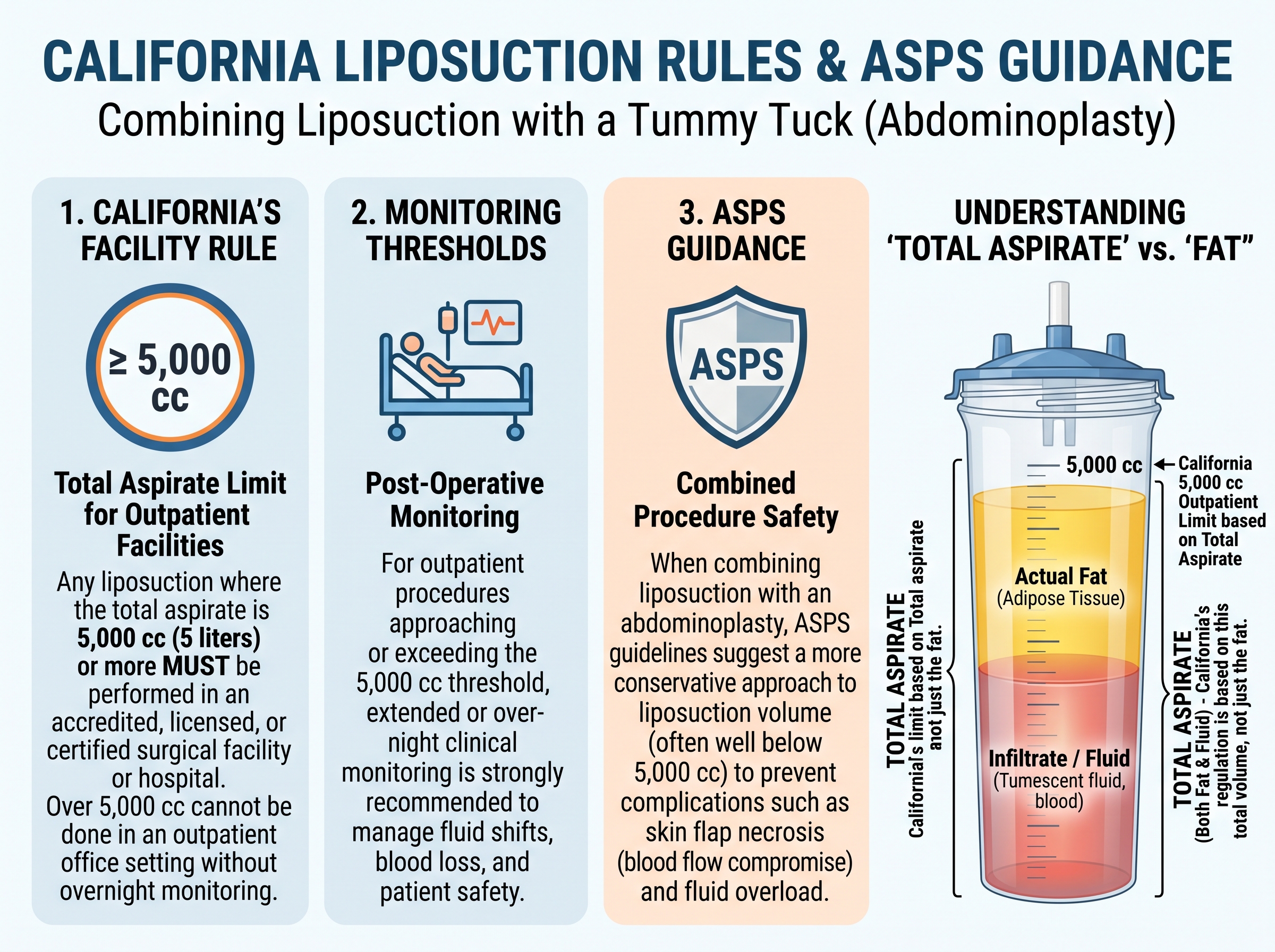
California requires any liposuction under general anesthesia or IV sedation, or of 5,000 cc or more of total aspirate, to take place in a hospital or an accredited, licensed or Medicare-certified surgical setting.
Since a tummy tuck is usually done under general anesthesia, a tummy tuck with lipo in California happens in one of those settings.
California doesn't set a fixed number for lipo combined with a tummy tuck. The amount is a medical judgment.
The American Society of Plastic Surgeons advises against combining large-volume liposuction with a tummy tuck.
The right amount depends on where the fat is, your overall health, the length of the operation, and the blood supply to the abdominal skin.
In most mommy makeovers, targeted liposuction of the flanks and waist delivers the biggest visible difference.
Why liposuction and a tummy tuck are often combined
A tummy tuck removes loose skin and repairs separated abdominal muscles, but it doesn't reshape the sides of your body much. Stubborn fat on the flanks, the lower back, and the area just above the pubic bone can make the waist look boxy. That can happen even when the front is flat. Liposuction addresses those areas.
The research agrees. A 2026 study followed 160 moms at a normal weight who had a tummy tuck with liposuction all the way around the waist. Their average waist shrank from 90.9 cm to 80.4 cm at six months. Satisfaction scores rose from 2.25 to 7.13 out of 10 (Yang et al., Frontiers in Surgery). That's why a tummy tuck is one of the most common pairings for liposuction at our practice.
The question isn't whether to combine them. It's how much to do at once.
What California's rule actually says
California sets its liposuction standards in Title 16, Section 1356.6 of its regulations. The key line reads:
"A liposuction procedure that is performed under general anesthesia or intravenous sedation or that results in the extraction of 5,000 or more cubic centimeters of total aspirate shall be performed in a general acute-care hospital or in a setting specified in Health and Safety Code Section 1248.1."
(Cal. Code Regs. tit. 16, § 1356.6 via Cornell LII)
What does that mean for you? A tummy tuck is usually done under general anesthesia. So in California, a tummy tuck with liposuction has to happen in a hospital or in an approved outpatient setting. Under Health and Safety Code Section 1248.1, that means a licensed surgical clinic, a Medicare-certified surgery center, or an outpatient setting accredited by an agency the Medical Board approves.
The same regulation sets safety standards for smaller liposuction done outside those settings. An IV line is required once volumes reach 2,000 cc. Between 2,000 and 5,000 cc, monitoring is required: pulse oximetry, blood pressure, fluid tracking and an EKG. A qualified licensed practitioner must provide the anesthesia. And no matter how much fat is removed, you can't go home until you meet standard recovery criteria, and only with a responsible adult.
Notice what's missing. California doesn't set a fixed number of cc for lipo combined with a tummy tuck. That leaves the amount to medical judgment, which is why the plan matters so much.
What accreditation means for your surgery
Accreditation isn't just a certificate on the wall. The Medical Board of California approves the agencies that accredit outpatient surgery settings. Those agencies (such as AAAHC, JCAHO, Quad A) must inspect each setting at least once every three years. Standards include a written emergency plan, credentialed staff, patient monitoring, and a transfer agreement with a local hospital.
It's a fair question to ask at any consultation: where will my surgery be done, and how is that facility accredited or licensed?
Total aspirate vs. actual fat: why 5,000 cc isn't 5,000 cc of fat
This is where most online explanations get confusing. It matters if you're comparing numbers from different practices or articles.
During liposuction, the surgeon first infuses tumescent fluid, a mixture of saline, a local anesthetic, and a medication that constricts blood vessels. What comes out through the cannula is a mix of fat, that fluid, and a small amount of blood.
Total aspirate is everything in the canister.
Actual fat (supernatant fat) is the fat layer that separates and floats to the top after the canister settles.
A liter of total aspirate might hold well under a liter of actual fat, depending on technique. So California's 5,000 cc threshold is a lot less fat than it sounds. And it's not a target. It's an outer boundary.
What the American Society of Plastic Surgeons recommends
The American Society of Plastic Surgeons keeps its office-surgery guidance simple. Office liposuction should generally stay under 5,000 cc. Large-volume liposuction shouldn't be combined with a tummy tuck.
The reasoning is practical. Large-volume liposuction shifts a lot of fluid, and a tummy tuck is already a substantial operation. Stacking both increases operating time, fluid shifts, and the demands on your body during recovery.
Why the central abdomen is treated differently
Location matters too. After a tummy tuck, the skin between the belly button and the incision is pulled tight. It also has a smaller blood supply. Heavy liposuction right there can slow healing.
Surgeons have developed ways to do more targeted work safely. In a review of 300 consecutive cases of abdominoplasty with abdominal liposuction that preserved key perforator vessels, the average abdominal aspirate was 660 cc (range 75 to 2,200 cc). The major complication rate was 1.3%, and the overall complication rate, including minor issues, was 17.3% (Smith and Smith, Plastic and Reconstructive Surgery). For context, the big study linking muscle repair to less back pain averaged 795 ml of liposuction with each tummy tuck (Taylor et al., Plastic and Reconstructive Surgery).
In practice, the areas most commonly treated with a tummy tuck are:
Flanks and waist. These usually give the biggest improvement in shape.
Lower back and bra line. Useful when fullness wraps around from the flanks.
Mons pubis. Small-volume contouring to keep the area in proportion with a flatter abdomen.
Upper abdomen. Treated conservatively, if at all, because of the skin's blood supply.
 Combination procedure involving breast augmentation (silicone implants), tummy tuck, and liposuction of the flanks.
 Liposuction of the back bra roll, arms, and Buffalo hump augmented by abdominal tightening.
Is it safe to combine liposuction with a tummy tuck?
For appropriately selected patients, yes. A 2024 analysis of 55,596 abdominoplasty patients found an overall complication rate of 2.1%. More than a quarter (27.2%) had other procedures at the same time. After adjusting for other factors, that didn't significantly raise the risk of major complications compared with a tummy tuck alone (Chaker et al., Aesthetic Surgery Journal).
That reassurance comes with a condition: the combined plan has to be reasonable. Operating time, volume, and the patient's health all carry weight. Longer operations are associated with higher rates of blood clots across surgery in general. In an analysis of more than 1.4 million patients, the longest procedures carried 27% higher odds of venous thromboembolism than average-length procedures (Kim et al., JAMA Surgery).
How Dr. Gabbay decides how much is right for you
Instead of starting from a legal maximum, Dr. Gabbay starts from the result you want and works backward to a plan that gets you there safely. During your consultation, he'll look at:
Where your fat actually is. Is the bulk on the flanks, the back, or inside the abdomen? Fat inside the abdomen can't be reached with liposuction at all.
Your weight and health. For a tummy tuck, it's best to be close to your goal weight. Being near a stable weight usually means less liposuction is needed in the first place.
The rest of your plan. If breast surgery is included, the total operating time goes up. A combined mommy makeover typically takes three to six hours.
Whether staging makes more sense. If you'd benefit from a larger liposuction, it may be safer as a separate procedure. Dr. Gabbay's practice offers large-volume liposuction as its own operation, where it isn't competing with a tummy tuck for time and fluid balance.
As Dr. Gabbay puts it, "Sometimes you need to just prioritize the things that you want changed." For more on that approach, read You Don't Have to Fix Everything: How to Prioritize a Mommy Makeover.
Questions to ask any surgeon about combined liposuction
These questions help you understand any plan for combined liposuction:
Which areas will you treat with liposuction, and which will you leave alone?
Roughly how much fat do you expect to remove, and is that measured as fat or total aspirate?
How long will the full operation take?
Where will the surgery be performed, and is the facility accredited?
Who will be managing anesthesia?
If I want more contouring than is safe in one day, what does a staged plan look like?
A surgeon who answers these clearly is one who's planning for safety as well as for your result.
Frequently asked questions
How much liposuction can be done with a tummy tuck?
It depends on your anatomy, your health, and the length of the full operation. California doesn't set a fixed combined number, but it requires liposuction under general anesthesia or sedation to take place in a hospital or an accredited, licensed or certified setting. The ASPS advises against combining large-volume liposuction with a tummy tuck.
Can I get lipo 360 with a tummy tuck?
Many patients have liposuction of the flanks, waist, and lower back with a tummy tuck. The amount is kept within a safe range, and the upper abdomen is treated conservatively to protect the skin's blood supply.
Does California limit how much liposuction I can have with a tummy tuck?
Not with a fixed number. California regulates where liposuction happens and how patients are monitored. Liposuction of 5,000 cc or more of total aspirate, or any liposuction under general anesthesia or IV sedation, must be done in a hospital or an approved outpatient setting.
Does liposuction during a tummy tuck increase recovery time?
It adds some swelling and bruising in the treated areas, but most patients recover from both at about the same time. Recovery is generally shorter than having the two procedures separately.
Can liposuction replace a tummy tuck?
Not if you have loose skin or muscle separation. Liposuction removes fat but doesn't tighten skin or repair muscles. See Tummy Tuck vs. Liposuction for a full comparison.
What if I want more liposuction than can be done safely in one surgery?
Dr. Gabbay can stage your plan into separate, scheduled procedures to prioritize your safety while still helping you achieve your desired aesthetic goals. Staging allows your body time to fully heal and recover between surgeries, reducing overall operative strain, fluid shifts, and risk of complications. During your consultation, he’ll discuss whether performing targeted liposuction first or completing your tummy tuck initially provides the best foundation for your ultimate results.
Plan your contour with Dr. Gabbay
The best result comes from a plan that fits your body and keeps your safety first. Schedule a consultation at our Beverly Hills office at 9454 Wilshire Blvd, Suite 710, or call (310) 205-9500. You can also browse abdominal liposuction results before your visit.
Sources
Medical Board of California. Cal. Code Regs. tit. 16, § 1356.6, Liposuction Extraction and Postoperative Care Standards.
Medical Board of California. Outpatient Surgery Settings.
American Society of Plastic Surgeons. Procedures in the Office-Based Surgery Setting.
Smith LF, Smith LF Jr. Safely Combining Abdominoplasty with Aggressive Abdominal Liposuction Based on Perforator Vessels: Technique and a Review of 300 Consecutive Cases. Plastic and Reconstructive Surgery. 2015.
Yang R, et al. Aesthetic abdominal contouring enhancement with combined abdominoplasty and circumferential liposuction in normal-BMI postpartum Asian women. Frontiers in Surgery. 2026.
Chaker SC, et al. Complications and Risks Associated With the Different Types of Abdominoplasties. Aesthetic Surgery Journal. 2024;44(9):965.
Kim JYS, et al. Surgical Duration and Risk of Venous Thromboembolism. JAMA Surgery. 2015;150(2):110–117.
Taylor DA, et al. Abdominoplasty Improves Low Back Pain and Urinary Incontinence. Plastic and Reconstructive Surgery. 2018.
This article is for educational purposes and isn't a substitute for an individual medical evaluation or legal advice. Regulations change. Individual results vary.