
You Don't Have to Fix Everything: How to Prioritize a Mommy Makeover
Jump To Section
Most moms who come in for a mommy makeover consultation arrive with a list. The stomach that won't flatten. Breasts that deflated after nursing. A bra roll, the flanks, maybe the arms. Sometimes the list feels so long that the whole idea starts to seem overwhelming, or out of reach.
Here's a different way to look at it. You don't need to fix everything at once, and you probably shouldn't. As Dr. Joubin Gabbay, a board-certified plastic surgeon in Beverly Hills, puts it: "Sometimes you need to just prioritize the things that you want changed. You don't have to change and nor should you change every single little thing."
That perspective tends to produce better results, safer surgeries, and more realistic budgets. Here's how to apply it.
Key takeaways
A mommy makeover is two or more procedures chosen for you, not a fixed package.
Start with the change that affects you every day, in clothes and out of them.
Match each concern to the layer causing it: skin, fat, muscle, or breast volume and position.
Keep the total operation within a reasonable length. When the list gets long, staging is often the smarter plan.
The decision is yours. Dr. Gabbay's role is to show you what each option can realistically achieve.
A mommy makeover is a plan, not a package
A mommy makeover is simply two or more procedures that address the changes that came with having kids. For most women that means some combination of a tummy tuck, breast surgery, and liposuction, but the combination is entirely individual.
A combined mommy makeover typically takes three to six hours, most patients return to normal activities in two to four weeks, and full recovery takes about six weeks. Those ranges are wide because the plans are so different. A tummy tuck with a breast lift is a very different day in the operating room from a tummy tuck, breast lift with implants, and liposuction of four areas.
For an overview of the procedures themselves, start with our Mommy Makeover Guide.
Why "everything at once" isn't always the best plan
There are real advantages to combining procedures: one anesthesia, one recovery, one stretch of time away from your kids and your work. The research is reassuring for well-chosen combinations. In a 2024 analysis of 55,596 abdominoplasty patients, 27.2% had other procedures at the same time, and the adjusted analysis found no significant increase in major complications compared with abdominoplasty alone (Chaker et al., Aesthetic Surgery Journal). A 2025 comparison of 726 patients found that mommy makeovers did not carry a higher rate of surgical site infection than isolated abdominoplasty; infection was actually more frequent in the tummy-tuck-only group (Wolf et al., Israel Medical Association Journal).
The limit is less about the number of procedures and more about total time and total stress on the body. In a study of more than 1.4 million surgical patients, the longest procedures carried 27% higher odds of a blood clot than average-length ones (Kim et al., JAMA Surgery).
There's no single right number of procedures for one day. It depends on your health, the specific procedures, and how long they take together. Prioritizing is how you get to the right answer for you. Dr. Gabbay walks through the safety side in this video on how many procedures are too many.
Step 1: Name the change that bothers you most
Before thinking about procedures, think about moments. When do you notice the change most?
Getting dressed and nothing fits the way it used to at the waist.
Wearing a swimsuit or fitted top.
Seeing yourself in profile at the end of the day.
Taking off your bra.
Working out and feeling like your core doesn't engage.
The one you notice every day is usually your priority. Many women find that a single concern, usually the abdomen or the breasts, drives most of their frustration. Addressing that first often changes how they feel about everything else on the list.
Step 2: Match each concern to what's causing it
Post-pregnancy changes come down to three layers: skin, fat, and muscle. Breasts add a fourth question: volume and position. Matching each concern to its cause prevents you from choosing the wrong procedure.
What you notice | Usual cause | Procedure that addresses it |
|---|---|---|
Belly pooch that sticks out even when lean | Separated abdominal muscles | Tummy tuck with muscle repair |
Loose or crepey lower-belly skin, overhang | Excess skin | Tummy tuck (full or mini) |
Flanks, bra roll, love handles | Localized fat | Liposuction |
Breasts sit lower, nipples point down | Stretched skin, sagging | Breast lift |
Breasts look empty, especially at the top | Lost volume | Implant, fat transfer, or tissue reshaping |
Both sagging and deflation | Both | Lift combined with volume |
Step 3: Rank by impact, not by length of the list
Once your concerns are matched to procedures, rank them by how much each would change your daily life. A few patterns come up often:
The abdomen is frequently the foundation. Muscle separation affects how clothes fit and, for some women, how their core feels. Research on tummy tucks with muscle repair has found meaningful improvements in low back pain and bladder leakage (Taylor et al., Plastic and Reconstructive Surgery). If that sounds familiar, read Does Every Tummy Tuck Include Muscle Repair?
Breasts are often the emotional priority. Many women say the change in their breasts is what they notice most privately. A lift, with or without added volume, can restore shape and position.
Liposuction multiplies the effect of the main procedure. Targeted liposuction of the flanks with a tummy tuck usually delivers more visible change than liposuction of many areas. It's often the best use of limited operating time.
Smaller areas can wait. Arms, inner thighs, or a small area of fat under the chin rarely need to happen on the same day as a tummy tuck and breast surgery.
Step 4: Check the total plan, then decide on one stage or two
With your top priorities chosen, look at the plan as a whole. Dr. Gabbay will estimate the total operating time and consider your health history, weight, and any risk factors for blood clots. A full tummy tuck alone generally takes two to five hours, and a breast lift can take one to four. Add liposuction and the day grows quickly.
If your priorities fit within a reasonable operating time, one stage is usually ideal. If they don't, a staged plan splits the work into two shorter surgeries a few months apart. Staging can also make sense if:
You'd like significant liposuction that's safer as its own procedure. See How Much Liposuction Can Be Done During a Tummy Tuck?
You're still working toward your goal weight, and body contouring should wait until your weight is stable.
You may want another pregnancy. Breast surgery and liposuction can be done as part of a mommy makeover even if you're planning another pregnancy, while the ASPS advises postponing a tummy tuck until you're done having children (American Society of Plastic Surgeons).
You need to spread out cost or time off work.
Staging isn't a compromise. For many women, it's the route to the same final result with a lighter recovery at each stage.
Two examples of a prioritized plan
These described examples are illustrative, not actual patients.
Priority: the abdomen. A mother of two, close to her goal weight, is bothered most by a lower-belly bulge and loose skin. Her breasts have lost some volume, but she's comfortable in a padded bra. A tummy tuck with muscle repair and flank liposuction gives her the biggest change in one operation. She decides to revisit her breasts later, if at all.
Priority: breasts and belly together. A mother of three has significant sagging and deflation, plus muscle separation. Both concerns matter equally to her. Dr. Gabbay plans a tummy tuck and a breast lift with added volume in one operation, keeping liposuction to the flanks so the day stays within a safe length. Additional contouring can be considered later.
Below are photos from Dr. Gabbay's actual patients who underwent surgery.
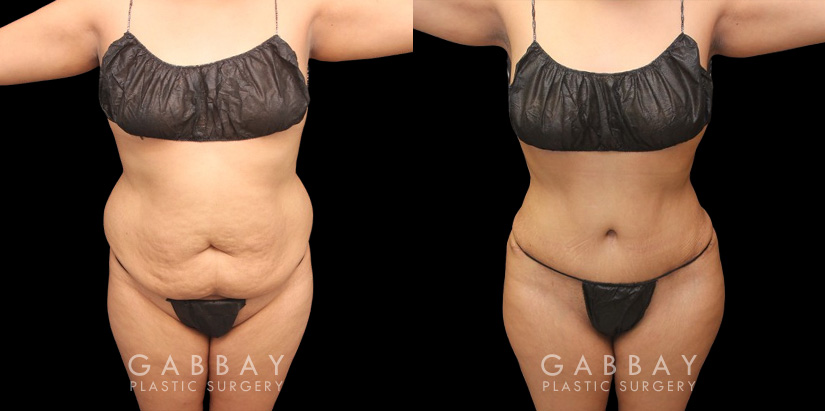 Mommy makeover with 360 lipo: waist curves back, flat belly, no visible scars. Smooth abs, no pregnancy stretch marks.
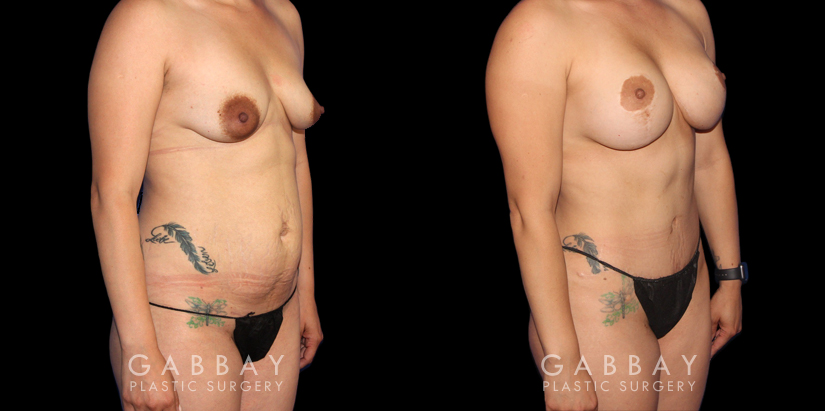 Mommy makeover: tummy tuck, breast augmentation, and lift with lipo for a smoother belly. Breast lift adjusted nipple position for better size, shape, and symmetry.
Nonsurgical support still matters
Whatever you choose, physical therapy, Pilates, or yoga after pregnancy is worth it, surgery or not. A stronger core supports your recovery and helps protect your result. And be wary of nonsurgical fat treatments sold as a fix for post-pregnancy changes. Dr. Gabbay is not a big fan of them for this, and he explains why in this video on skin, fat and muscle.
In the end, the decision is yours and yours alone. A consultation should leave you with clear information and no pressure.
Questions to bring to your consultation
Which of my concerns will make the biggest difference if we treat them first?
What's the estimated operating time for everything on my list? For just my top two?
Is there anything on my list that's better treated separately?
If I plan another pregnancy, what should wait?
What would a staged plan look like, and how far apart would the stages be?
For timing after pregnancy and breastfeeding, see When Is the Best Time to Get a Mommy Makeover?
Frequently asked questions
Do I have to get every procedure in a mommy makeover?
No. A mommy makeover is any combination of two or more procedures chosen for your concerns. Many women choose two procedures, such as a tummy tuck and a breast lift.
Should I do the tummy tuck or breast surgery first?
If you're staging, start with the concern that affects you most. If you might have another pregnancy, breast surgery and liposuction can often come first, and the tummy tuck can wait until you're finished having children.
How many procedures can be done safely at once?
There's no single number. It depends on your health, the procedures, and the total operating time. Dr. Gabbay's mommy makeovers typically take three to six hours.
Is a staged mommy makeover more expensive?
It can cost more overall because some facility and anesthesia fees apply to each surgery. Staging can also make each stage more affordable and each recovery shorter. Ask about financing options.
How far apart are staged procedures?
Usually at least a few months, so you've fully recovered from the first stage.
Start with your priorities
Bring your list to a consultation and Dr. Gabbay will help you sort out what will make the biggest difference and what can wait. Schedule a consultation at our Beverly Hills office at 9454 Wilshire Blvd, Suite 710, or call (310) 205-9500. You can also begin with a virtual intake and browse mommy makeover results.
Sources
Chaker SC, et al. Complications and Risks Associated With the Different Types of Abdominoplasties. Aesthetic Surgery Journal. 2024.
Wolf Y, et al. A Comparative Analysis of the Complication Rate in "Mommy Makeover" Procedures and Abdominoplasty. Israel Medical Association Journal. 2025.
Kim JYS, et al. Surgical Duration and Risk of Venous Thromboembolism. JAMA Surgery. 2015.
Taylor DA, et al. Abdominoplasty Improves Low Back Pain and Urinary Incontinence. Plastic and Reconstructive Surgery. 2018.
American Society of Plastic Surgeons. Tummy Tuck.
This article is for educational purposes and isn't a substitute for an individual medical evaluation. Individual results vary.